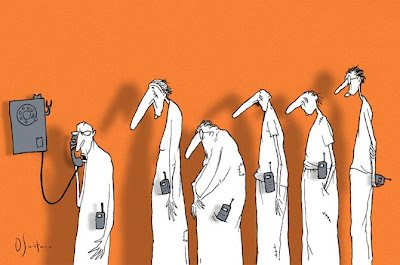
Showing posts with label mobile. Show all posts

Wednesday, October 5, 2011

Project: Help Young Cubans Connect Through Cell Phones


Summary


By purchasing and shipping new Cuba capable cell phones, we are boosting connectivity among youth in Cuba. With these modern tools, youth in Cuba can start becoming the authors of their own future.

What is the issue, problem, or challenge?


At the end of 2010, fewer than 8% of the Cuban population will have access to cell phones. In other developing countries, cell phones--especially SMS text services--have been used as low cost ways of sharing news about job opportunities, organizing and connecting civic groups, and broadcasting news that could otherwise be censored by the official press. Cell phone access remains limited today, which restricts Cubans' abilities to inform, advise and act on up-to-date information.

How will this project solve this problem?


Our project provides pre-paid calling cards and new, Cuba-ready phones for youth on the Island. These young people can use their new cell phones to not only communicate with each other, but also to connect with the world outside of Cuba.

Potential Long Term Impact


By increasing young peoples' connectivity, we provide Cuban youth with a means of educating and organizing themselves. In the process, we promote their self-determination and give them a tool for creating positive social change.

Project Message


Since I was born in Cuba, I could have been the young man I am today in a country separated from the outside world. I want to see that each day less and less young persons in Cuba are disconnected.
- Miguel Cruz, Cell Phones for Cuba Project Manager

Give Now

Funding Information


Total Funding Received to Date: $5,095
Remaining Goal to be Funded: $17,405
Total Funding Goal: $22,500
 

Additional Documentation


This project has provided additional documentation in a Microsoft Word file (projdoc.doc).


  • Go to Home Page
  • Tuesday, August 9, 2011

    Corruption in Cuba - Telephone executives arrested


    ETECSA executives arrested, one defected in Panama. 

    A new large-scale corruption scandal involving yet another Cuban government ministry, Informatics and Telecommunications, is unfolding in Havana, reported Reuters.

    While no statement has been forthcoming from offical Cuban sources, several executives of ETECSA, Cuba’s monopoly telecommunications company, including its President Maimir Mesa, are under arrest, states Havana based journalist Marc Frank on Tuesday.

    Reuters further reported:

    “Five or six department directors and deputy directors, and maybe a vice president, have been arrested so far and the vice president of logistics, who was in Panama when the investigation began, decided not to return.”

    “But the investigation has just begun and many more people might be involved,” the noted the news agency, adding that a retired company vice president was brought to Havana for questioning.

    The sources told Reuters that two separate investigations underway, one at ETECSA, involving its booming cellular phone business, and the other into a submarine fiber optic cable financed largely by Venezuela that links Cuba to that country.

    The cable reached Cuba in February but has yet to become operative with the online date pushed back from July to September or October. It is unknown whether the corruption case has anything to do with the failure to meet its widely-touted startup date.

    The government of Raul Castro has already prosecuted and sentenced dozens of officials and executives for charges and the president says he will continue to come down hard on abuses found.

    Soon after succeeding his ailing brother Fidel in 2008, Castro created the Office of the Comptroller General and put the comptroller on the ruling Council of State.

    Hundreds of senior Cuban Communist Party officials, state managers and employees have lost their jobs and often their freedom in the shake-up that has followed.

    It has included the breaking up of high-level organized graft in the civil aviation, cigar and nickel industries, and at least two ministries and one provincial government.

    Sources: Reuters and Havana Times


  • Go to Home Page
  • Monday, July 18, 2011

    Cell phones and the cost of living in Cuba

    Courtesy of Omar Santana.

    When I first came to Cuba in 1995, cell phone service was so scarce that, after a meeting in which an official had flashed a cell phone from the podium, I turned to Abel Prieto, then the president of the writer’s union, and asked if he had one too.

    “Oh, no,” he said, “I’m not high enough to be part of the celucracia.”

    The cellucracy!

    In later years, of course, Abel became the minister of culture and acquired a pocketful of cells, and I began to know people – rarely connected with government – who had one too. But the stories behind their cells were always complicated and strange.

    The reason was that Cuba did not allow its citizens to legally own cell phones until 2008. That’s right, 2008 – 45 years after its invention, Cubans finally got a chance to own a cell.

    Prior to that, to have a cell phone meant you were either very high in or very important to the government, or you had an European or Canadian connection – a foreigner willing to get a phone and cell service in her name and let you use it. It was an exclusive club, and pulling a cell out in public elicited envy, awe, and not a little bit of fear.

    After 2008, though, cell phones have become ubiquitous. The lowliest delivery boy has one attached to his belt. That is not, of course, in and of itself surprising. Like in so much of the Third World, cell service in Cuba doesn’t require the wait for a land line, which can be months or even years. If you have the right kind of apparatus, you can sign up for service on the same day.

    But what is curious is the chasm between the cost of cellular service and the official Cuban monthly salary.

    You see, after you pay the $30 CUCs – Cuba’s convertible peso, which is at about 0.87 per U.S. dollar – to establish a cell line, you need to buy phone cards to charge the phones at approximately 45 centavos a minute, or about 50 US cents.

    This means that cell phone usage in Cuba isn’t casual. It’s about location, or getting someone to drop a key from a higher floor to open a lobby door, or to ask someone to get to a landline for a real conversation. Cell phones, of course, also facilitate texts, which has been a boon for dissidents and their responders, both groups which have taken to Twitter like an addiction.

    But how, you might ask, can a Cuban earning between $15 and $20 USD a month pay such a steeply priced cell service? The answer is that, at least officially, they can’t.

    And this is where the Cuban government, regardless of its staunch public posture against corruption (especially under Raul Castro), colludes with and counts on the country’s rich black market. Because, really, otherwise how can a Cuban earning $15-$20 USD a month have cell service that ends up being twice that?

    Cell service is one of the many things that, prior to Raul, had been illegal but not uncommon for Cubans. In fact, many of his so-called reforms have been merely bringing into legality what had become common illegal practice: among other things, access for Cuban citizens to hotels, access to car rentals, access to DVD rental of foreign films, access to markets for individual farmers and artisans, and the ability to run a legal business, especially in sales or personal services.

    In the case of the cell service, the government assumes its citizens are getting their funds from abroad or through illegal means. As a friend of mine explained, it’s Cuba’s version of Don’t Ask Don’t Tell: The government agrees not to question source of income so long as the citizen agrees to pay the exorbitant fee.

    Added my friend: “It’s not exactly like we have a choice anyway.”

    by Achy Obejas


    Source: WBEZ


  • Go to Home Page
  • Thursday, September 30, 2010

    Cuba’s new ‘blogger-in-chief’

    Cubans line up in front of a Havana Internet Café
    on Obispo street in Old Havana.
    Fidel Castro has gone from Cuba’s commander in chief to its de facto “blogger-in-chief,” posting constant opinion columns online, singing the praises of the internet age, even hailing Wikileaks and sites like it as the common man’s tool to greater worldwide transparency.

    Now, if only his fellow Cubans could get in on the cyber-party.

    Less than 3 percent of islanders used the internet at least once over the past year and only about 6 percent used email, according to a nationwide survey released Thursday by the state-run National Office of Statistics.
    Cuba has long published annual statistics on its internet and cell phone users. But the level of detail contained in this survey had not been made public before – and it revealed a country astoundingly behind the technological times.

    Just 2.9 percent of survey responders said they had used the internet in the past 12 months, and the majority of those did so at work or school – not from home. Cuba only legalised the sale of computers to the general public in 2008, though they were, and still are, widely available on the black market.

    The tally paints a far bleaker picture than the statistics office’s annual report on connectivity, which found that Cuba had 1.6 million internet users last year. But even that is far below internet access in any other country in Latin America, according to international surveys.

    Statistics officials based their study on interviews with 38,000 households across the island from February to April. The office did not say whether the survey was done in person or over the phone, and it listed the margin of error only as less than five percentage points.

    It was not clear how many Cubans themselves would see the statistics, however, since they were posted on the agency’s website.

    The communist government severely limits Web access, but says it has no choice given that Washington’s 48-year-old embargo doesn’t allow Cuba to access US service providers located close by. Instead, the island must rely on slow and costly Internet via satellite from Europe and other faraway locales.

    Meanwhile, authorities block blogs that are critical of the government as well as other pages containing content that is considered counter to Castro’s 1959 revolution.

    Venezuelan President Hugo Chavez has promised to lay a fibre-optic cable from his country to Cuba to improve connectivity here, but those plans have been stalled for years.

    Of those surveyed by the National Office of Statistics, only 5.8 percent said they use e-mail. The survey did not say how often.

    Ordinary Cubans can join an islandwide network that allows them to send and receive international e-mail, but lines are long at youth clubs, post offices and the few Internet cafes that provide access.

    The survey also found that just 2.6 percent of respondents regularly use cell phones, despite the government’s dramatic lifting of bans on them two years ago. That was slightly higher than the 2.5 percent who said they own cell phones or have been issued them for work _ meaning some are using phones that belong to relatives, friends or neighbours.

    Those percentages are substantially lower than previously released figures, with the state-controlled telecommunications monopoly reporting in July that more than 1 million cell phone lines were in use nationwide. Cuba has a population of 11.2 million people.

    Mobile phones in Cuba had been prohibited for all but tourists and foreigners, some government employees, business officials and academics. But in April 2008, just two months after he succeeded his brother as president, Raul Castro authorized their sale to all who could afford them.

    From:  Updated News

  • Go to Home Page